The Orbital Servicing Wars - Part II: Dissecting Vulnerabilities
How today’s orbital servicing architectures hold up under extended conflict, and what their failure modes reveal about doctrine, deterrence and national power.

This piece follows “The Orbital Servicing Wars - Part I”, which examined how China, the United States, and Europe have approached the development of space servicing capabilities over the past 15 years - from commercial breakthroughs to national strategies. Reading Part I will provide context to follow the framework and commentary in this article.

A. OSAM Strategic Capability Pyramid
Current approaches to analyzing On-Orbit Servicing, Assembly, and Manufacturing (OSAM) capabilities treat these technologies as binary propositions that either work or fail, focusing primarily on technical feasibility rather than their strategic utility under operational stress. This perspective fails to capture how OSAM capabilities create layered advantages that compound over time. We have to also recognize that some of these capabilities will expose new vulnerabilities as platforms transition from commercial services to military assets.
Commercial solutions will typically evaluate OSAM systems against peacetime performance metrics, asking whether satellites can be refueled, repaired, or repositioned successfully. However, the strategic value of these capabilities emerges not during routine operations but under crisis where conventional replacement timelines are moot and operational requirements exceed peacetime parameters. We are no more asking whether OSAM capabilities will work - but how the different architectural approaches in consideration today perform across escalating threat scenarios.
Note: This article uses the abbreviation OSAM (On-Orbit Servicing, Assembly, and Manufacturing), consistent with its technical roots and its focus on Earth-orbit architectures. While ISAM (In-Space Servicing, Assembly, and Manufacturing) is increasingly used in policy and includes lunar or deep-space contexts, the terms are essentially synonymous for orbital servicing purposes.
A Four-Layer Framework for Strategic Assessment
To address this analytical gap, I organize OSAM capabilities into four distinct layers that capture both their strategic progression as well as how their vulnerabilities evolve. Each layer builds upon capabilities mastered in lower layers while introducing new operational complexities and exposure to adversary disruption.
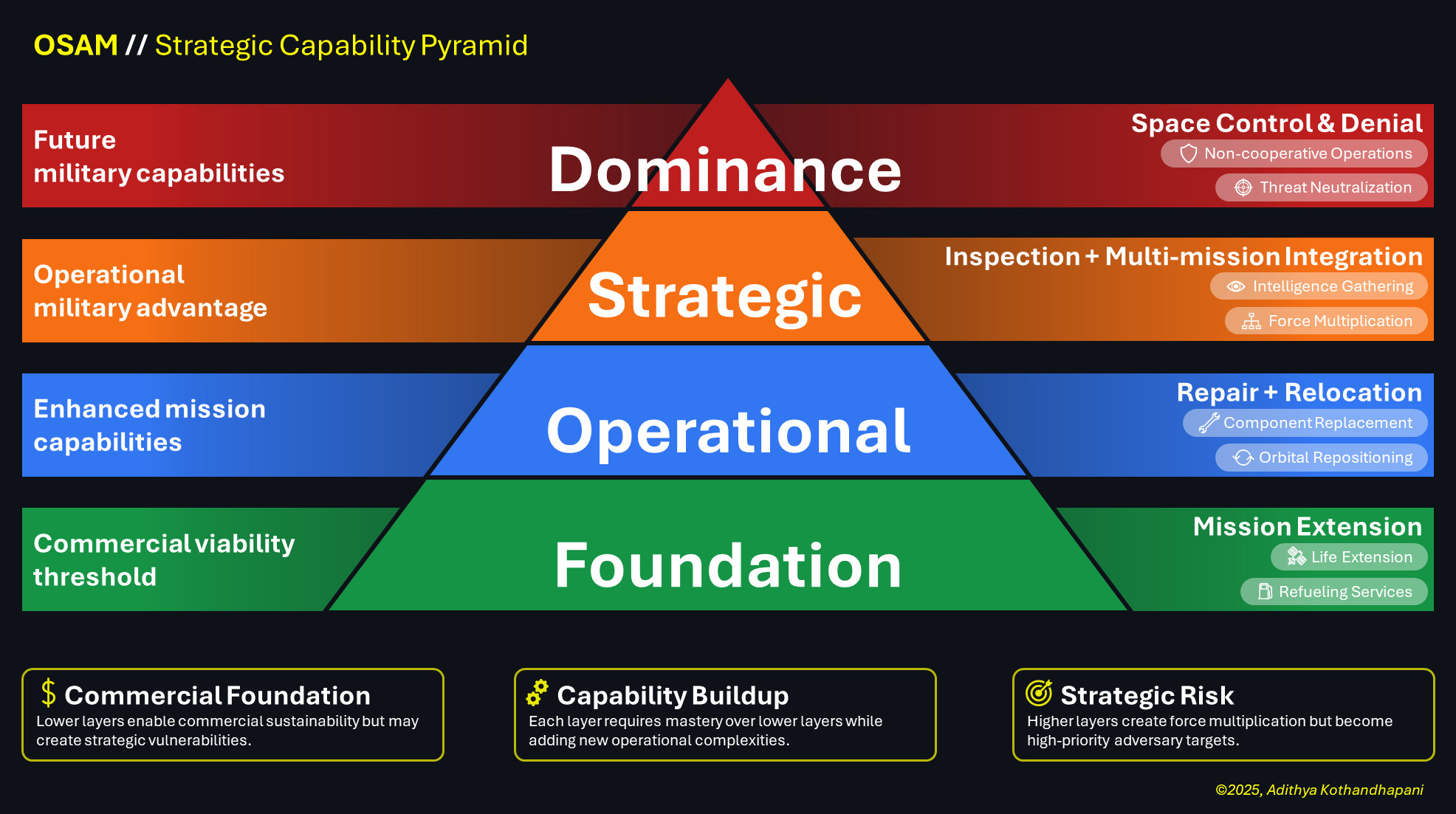
Foundation Layer includes basic mission extension services focused on prolonging operational satellite life through refueling, power system augmentation, or replenishment of other consumables. These capabilities represent today’s state: satellite servicing transitioning from experimental concept to operational reality. Success at this layer demonstrates technical feasibility - and if the market has the appetite - represents crossing of the commercial viability threshold. Examples: MEV-1 and MEV-2, Shijian-25 refueling mission.
The Operational Layer encompasses enhanced mission capabilities extending beyond life extension to component replacement and orbital repositioning. This level requires sophisticated manipulation systems and proximity operation capabilities that enable satellites or constellations to reconfigure rapidly in response to threats or changing operational requirements. Platforms operating at this layer possess the technical sophistication necessary for physical interventions. Examples: China's Shijian-21 debris removal, MEV-1’s disposal of Intelsat 901.
Strategic Layer includes force multiplication capabilities where individual servicing platforms enable broader strategic effects through intelligence gathering, threat assessment, and coordinated operations across multiple mission areas. At this level, platforms transition from supporting existing assets to actively shaping the space operational environment through direct intervention capabilities. Examples: GSSAP inspection missions, Russia’s suspected Luch/Olimp inspector series and even HEO Robotics' commercial Non-Earth Imaging service.
Lastly, the Dominance Layer represents future military capabilities for non-cooperative operations and space control that extend beyond current OSAM scope to actively and directly shape the space operational environment. Platforms at this level transition from just supporting friendly assets and monitoring others’ assets to controlling adversary space operations.
Limiting Scope to Lower Layers
Given the limits on what we can observe, we can probably only focus on the Foundation and Operational layers where sufficient operational data exists to support a meaningful assessment. We simply lack the operational experience necessary to analyze the Strategic and Dominance layers as most activities remain experimental or highly classified. Also, we still haven’t truly crossed the commercial viability threshold - which is my areas of interest.
The constraints we face in making assessments and prediction is not merely from an analytical standpoint but reflects the genuine uncertainty facing military planners. Without operational precedent for upper-layer capabilities, decision-makers will base architectural choices on Foundation and Operational layer performance while recognizing that strategic competition will ultimately extend into domains where operational experience remains limited. Building an understanding of how lower-layer capabilities perform under stress provides a foundation to anticipate how more sophisticated systems might behave in the contested environments of the future.
B. Crises in Prolonged Space Competition
Space competition between major powers will not follow the binary peace-war model that characterized terrestrial conflicts of the 20th century. Instead, space domain competition will likely unfold through extended grey-zone operations where adversaries attempt to degrade each other's space capabilities without crossing thresholds that trigger direct military response. This prolonged competition model reflects both the strategic value of space assets and the catastrophic consequences of open space warfare that will damage all participants through debris generation.
Historical precedents support this grey-zone hypothesis. Economic warfare during the Cold War, cyber operations in the 2010s, and current supply chain disruptions demonstrate how adversaries can impose significant costs while maintaining plausible deniability or operating below traditional escalation thresholds. Space competition follows similar patterns, where actions against space infrastructure can be attributed to technical failures, market forces, or even implicate non-state actors rather than admit direct government action.
Scenarios: From Production Constraints to Launch Denial
In order to test each OSAM architecture in a given layer on its resilience to operational stress, we will employ eight progressive crisis scenarios that reflect an escalation pattern based on adversary risk tolerance and operational complexity. Each scenario represents increasing willingness to accept attribution risk and operational exposure.
Production Constraints represent the initial escalation phase where adversaries may target manufacturing capacity, supply chains, and skilled workforce through economic pressure, export controls, or industrial espionage. This approach imposes costs while maintaining attribution ambiguity, as evidenced by current semiconductor export restrictions and rare earth element supply vulnerabilities.
Cyber Warfare against space systems follows naturally as adversaries gain confidence in their ability to conduct operations with limited attribution risk. Targeting satellite command and control systems, ground infrastructure networks, and manufacturing facilities allows significant disruption while maintaining deniability that characterizes modern cyber operations.
Ground Infrastructure Attacks represent escalation toward kinetic operations but target terrestrial assets where conventional military responses apply. Attacks against satellite control facilities, launch sites, and communication nodes impose severe constraints on space operations while remaining within traditional military operational domains.
ASAT Targeting crosses into direct space warfare through kinetic destruction or non-kinetic effects including jamming, spoofing, and cyber attacks that disable satellites without creating debris. Non-kinetic effects themselves represent qualitative escalation because it demonstrates capabilities that fundamentally alter strategic balance while avoiding debris that affects all - including the belligerent.
Launch Denial represents the ultimate escalation scenario because it eliminates the primary mechanism for space capability reconstitution. Unlike other scenarios that degrade existing capabilities, launch denial prevents recovery and forces reliance entirely on assets already in orbit.
Launch denial differs qualitatively from preceding escalation steps as it transforms space competition from capability degradation to capability elimination during the denial period. While launch infrastructure can eventually be rebuilt and mobile systems like TELs can provide limited access for smaller payloads, the temporary elimination of heavy-lift capability forces complete reliance on orbital assets during reconstruction timelines that may span months (or years in peacetime). This scenario makes satellite servicing architectures the primary determinant of sustained space operations during the most critical phase of extended competition.
I have tried layering each escalation such that it compounds previous vulnerabilities and eliminating recovery mechanisms that earlier scenarios left intact, creating cascading effects that can make architectural choices increasingly critical as competition intensifies.
C. Vulnerability Assessment
Methodology
We will evaluate OSAM architectures in play today across two dimensions: baseline capability during normal operations and its degradation under progressive crisis scenarios. Each architecture receives capability ratings (High/Moderate/Limited) for core mission categories, then undergoes systematic stress testing across the escalation ladder.
I have separated architectures by their design philosophy rather than specific technical implementations:
Direct Refuel systems optimize for single-mission efficiency - e.g. DARPA’s Orbital Express,
MEV/Piggyback approaches maximize commercial viability through proven market demand,
Depot + Shuttle architectures emphasize flexibility through centralized infrastructure - e.g. OrbitFab’s Gas Station concept,
Robotic Capture systems prioritize versatility through sophisticated manipulation capabilities - e.g. Shijian-21/Beidou-2 mission, and
MEV-Refueler Hybrid approaches balance reusability with operational flexibility - e.g. Shijian-25/Shijian21 mission.
As we will see further, studying crisis-time degradation reveals two distinct failure patterns: ‘cliff-edge failures’ where architectures lose most capability immediately when specific vulnerabilities are exploited, and ‘graceful degradation’ where architectures maintain partial capability across multiple scenarios. This distinction is critical because graceful degradation provides operational flexibility during extended competition while cliff-edge failures create sudden capability gaps, risking an abrupt loss of agency.
Foundation Layer
Foundation Layer capabilities focus on mission extension through refueling and life extension services. Commercial viability appears as a capability metric because crossing this threshold demonstrates sustainable revenue streams and self-sustaining industrial capacity that can support military requirements without depending entirely on defense budgets.
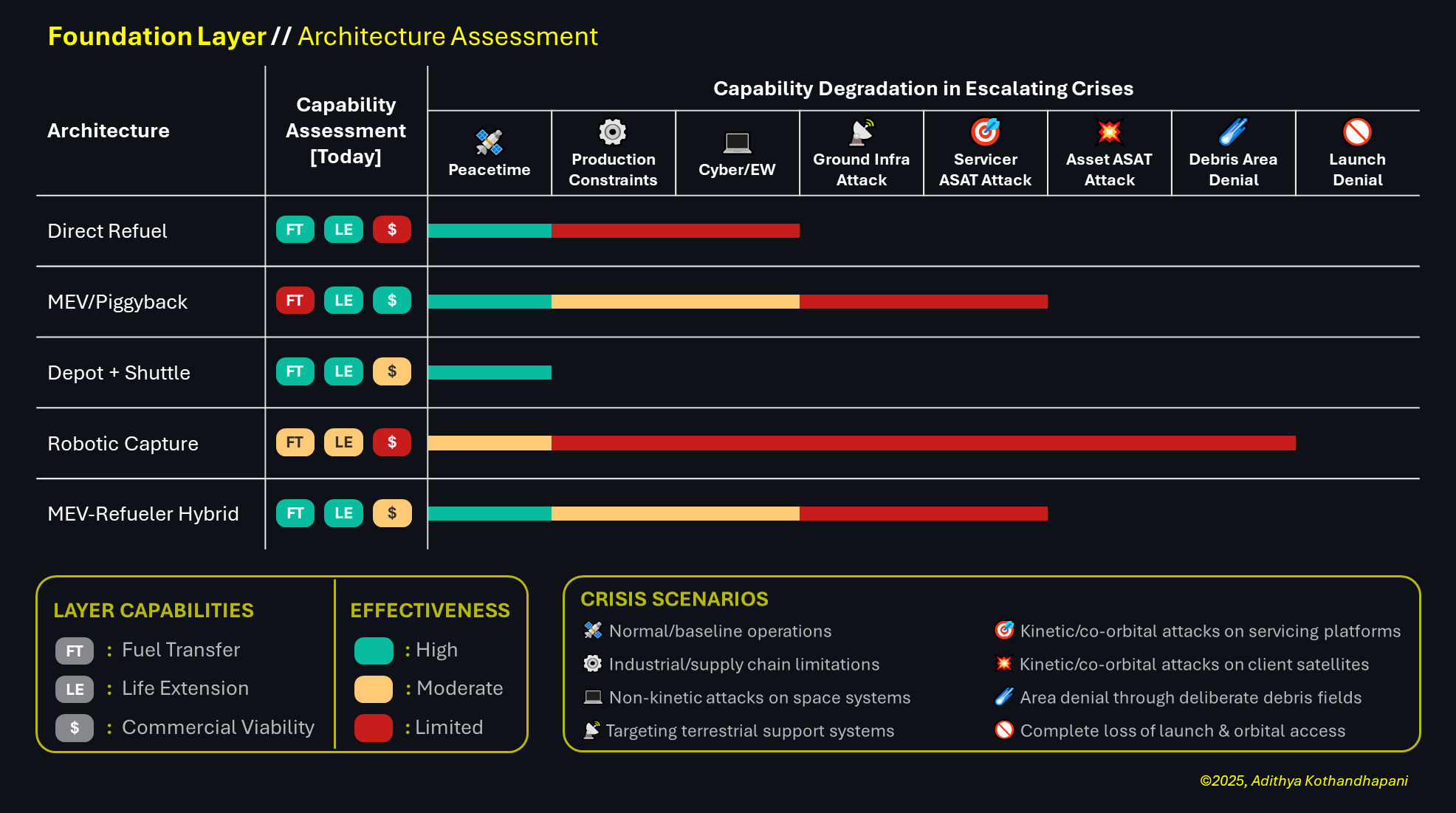
The assessment shows that MEV/Piggyback architecture achieves maximum baseline capability during peacetime but degrades through distinct vulnerability patterns. Production constraints limit new servicer availability, reducing coverage to additional clients. Cyber warfare targeting servicer command systems or client interfaces disrupts operations. Ground infrastructure attacks affect control facilities, creating coordination failures. ASAT targeting eliminates capability entirely once servicer population drops below operational thresholds.
The Depot + Shuttle architecture fails under production constraints because it depends on continuous resupply of fuel depots and shuttle vehicles. Production constraints eliminate the ability to replenish fuel stocks and replace vehicles, creating a cliff-edge failure where the system becomes inoperable once depot fuel is exhausted.
Robotic Capture systems demonstrate superior survivability through operational flexibility, enabling multiple mission types from a single platform. These systems can adapt their operational profile in response to threats: conducting debris removal for cover, switching between cooperative and non-cooperative targets, and repositioning within their orbital regime. This architectural flexibility preserves partial capability even under stress.
Crisis Test: GPS Constellation Support during Extended Competition
To orient military readers on how to perform similar assessments of their own or adversary capabilities, here is a sample conflict scenario that is grounded in today’s world with known limitations:
Production constraints limit GPS III satellite availability while multiple GPS IIF satellites (launched 2010-2016) approach fuel depletion simultaneously across orbital planes A, D, and F. Traditional replacement assumes 18-month procurement and launch timelines now extended to 30+ months. MEV/Piggyback approaches require pre-positioned servicers in affected planes before the crisis - failure to anticipate which planes need support first creates coverage gaps. Cyber warfare targeting ground control infrastructure makes centralized MEV systems vulnerable, stranding both servicer and client satellites.
Operational Layer
Operational Layer capabilities encompass component replacement and orbital repositioning that extend beyond basic life extension. Current development programs have set limited operational precedent while only demonstrating technical potential. US programs like SSC's Tetra and ROOSTER are exploring these technical boundaries but remain experimental rather than operational.
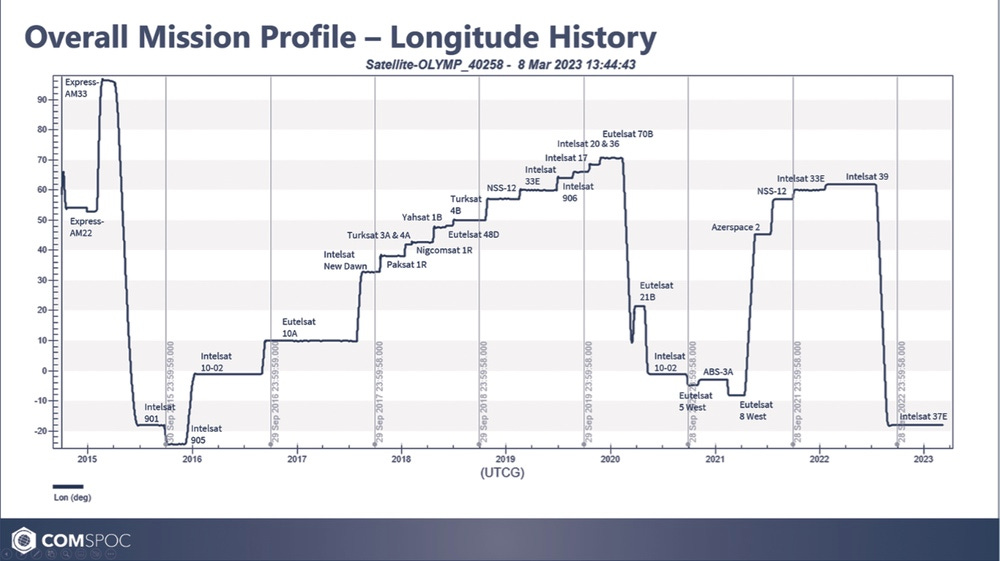
Russian architecture capabilities, demonstrated through Kosmos proximity operations in Low Earth Orbit (LEO) and Luch/Olimp-K satellite maneuvers, show development of inspection capabilities. However, sustained operational deployment remains limited, reflecting the technical challenges inherent to the Operational Layer.
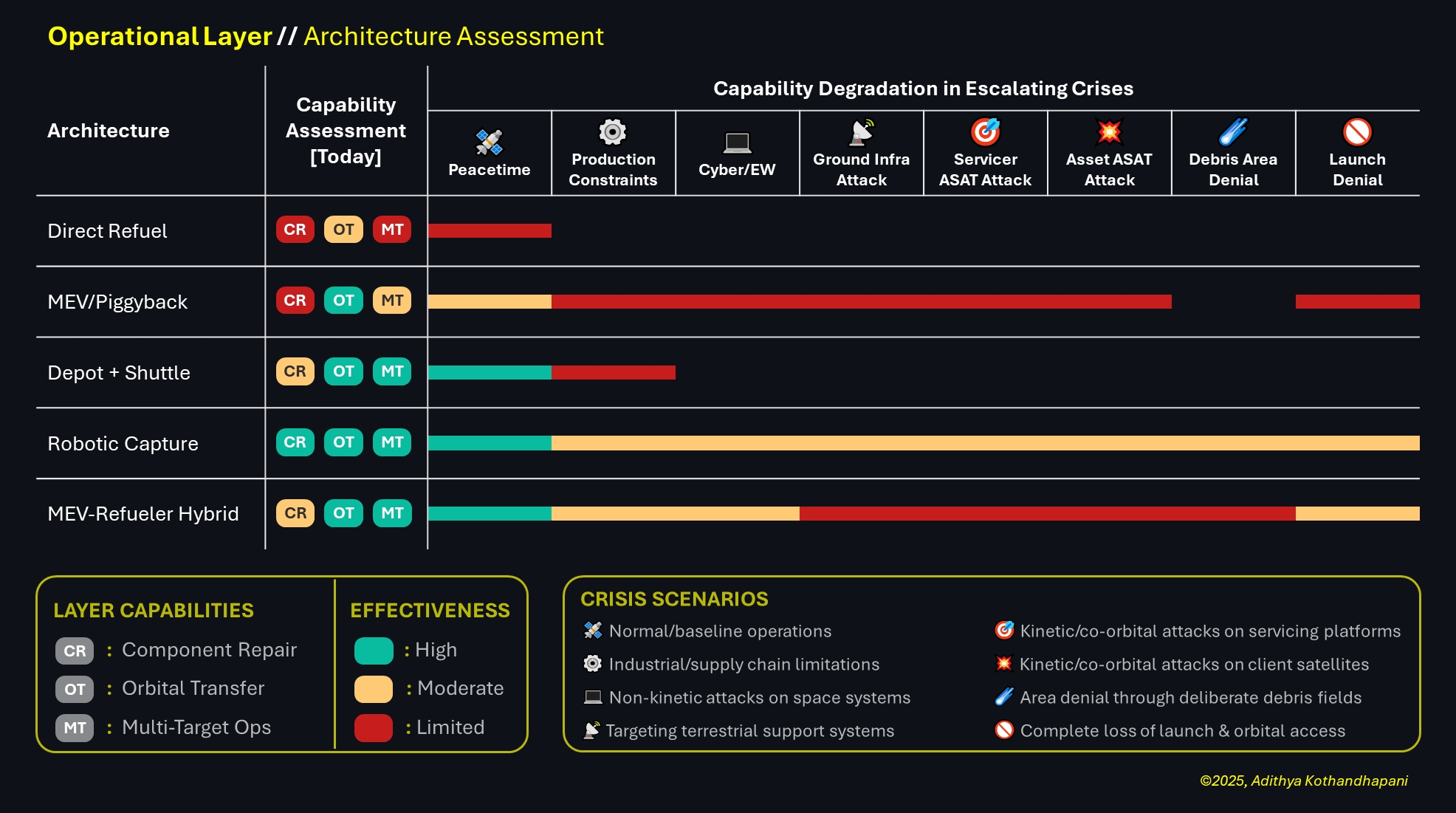
Capability assessment reveals a clear division between architectures designed for simple life extension versus those capable of complex physical interventions. Robotic Capture systems excel through manipulation capabilities, while traditional approaches like MEV/Piggyback show fundamental limitations in component replacement. Northrop Grumman's Mission Robotic Vehicle (MRV), developed through DARPA's RSGS program, positions its performance between MEV/Piggyback and Robotic Capture architectures.
Crisis Test: High-Value Asset Recovery Under Launch Constraints
During prolonged gray-zone competition, critical national security satellites require orbital repositioning or capability enhancement when conventional replacement options are unavailable due to specialized payloads, launch restrictions, or supply chain disruptions.
A navigation satellite stranded in geostationary transfer orbit (e.g. India’s NVS-02) requires complex orbital maneuvering (typically 1,500+ m/s delta-V for GTO-to-GEO transfer) beyond its onboard propulsion. During extended competition, launch access is constrained and dedicated missions broadcast obvious signals.
For immediate deployment, on-demand recovery missions will face severe production constraints and limited access to launch. For persistent capability, only architectures that survive extended targeting pressure justify maintaining ready assets in orbit. Robotic Capture systems retain operational flexibility through multiple mission modes, while MEV-Refueler Hybrid approaches provide sustained operational presence. Depot + Shuttle systems collapse under production constraints.
Common Degradation Patterns
Analysis reveals fundamental tension between optimization for commercial viability and crisis resilience. Architectures optimized for peacetime efficiency, particularly infrastructure-dependent approaches, suffer catastrophic capability loss under crisis conditions. The implications for strategic planning are clear: architectural choices must prioritize sustained performance under stress rather than peak capability during normal operations.
D. Implementation Guide: Applying the Framework for Resilience Assessment
The following flowchart captures the workflow I used to perform this assessment. Do note that it contains steps beyond the ones described in this article.
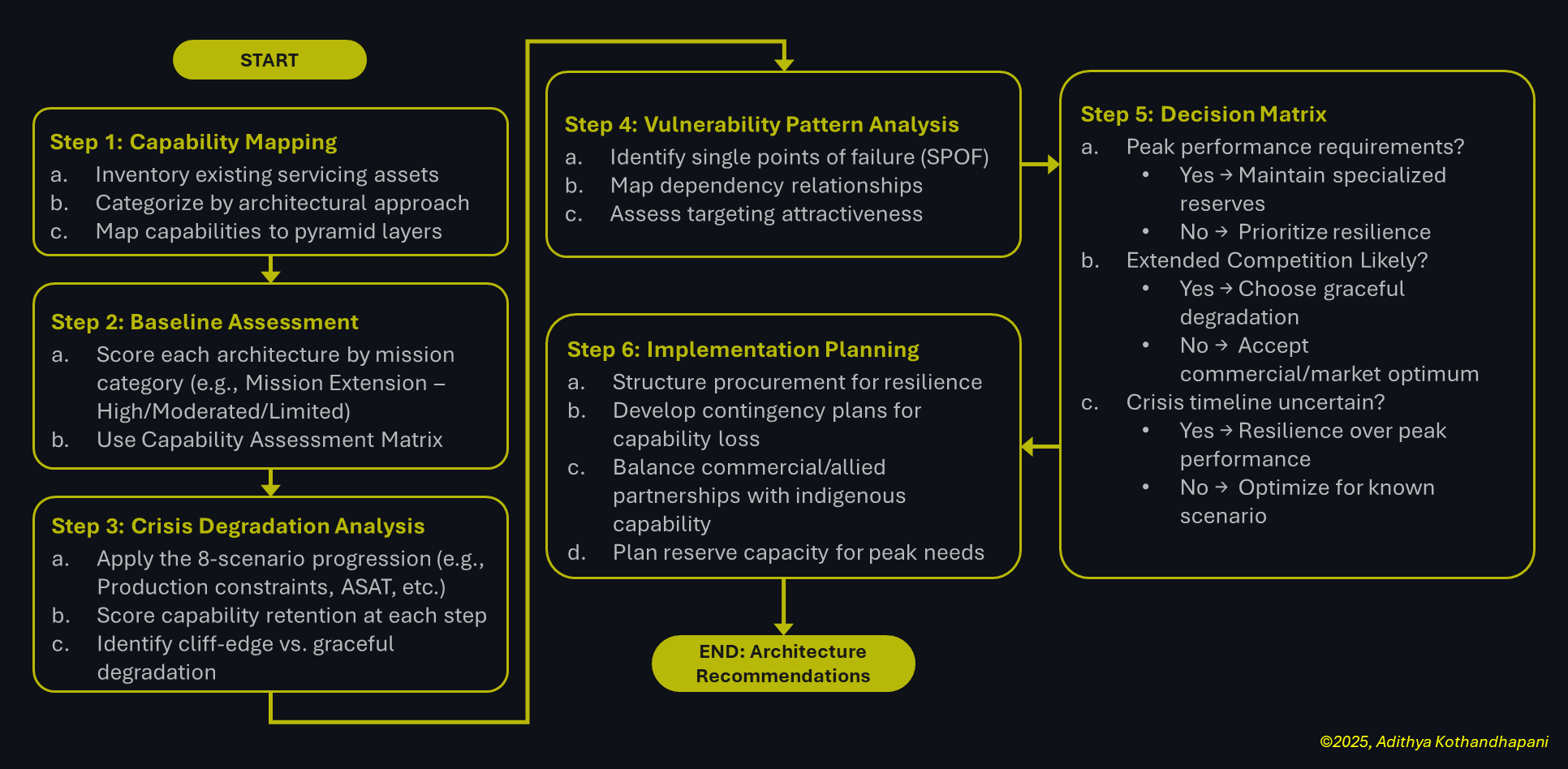
While applying this framework, keep the following in mind:
Assessment Scope Limitations: Focus simulation efforts on layers that have sufficient operational data to support meaningful analysis - no point evaluating hypothetical needs and capabilities that do not meet their own prerequisites.
Commercial Opportunity Identification: Leverage commercial capabilities when they demonstrate crisis resilience rather than just peacetime efficiency. HEO Robotics exemplifies how market-driven innovation can accidentally solve problems military planners struggled to articulate. Prioritize distributed capabilities over centralized infrastructure for resilience under targeting pressure. However, excessive commercial optimization for peacetime markets creates strategic brittleness during extended competition.
War-Gaming Applications: Structure scenarios around the crisis progression framework, testing different architectural combinations against realistic threat sequences. Score each capability to establish baseline performance, then apply degradation factors systematically across escalation scenarios. This reveals which architectural choices maintain effectiveness under sustained pressure versus those providing peak performance but failing catastrophically when stressed.
Strategic Framework Context: This framework addresses capability assessment rather than threat prediction. Focus on building architectures that perform across multiple threat scenarios rather than optimizing for specific conflict projections, as strategic value emerges from maintaining operational flexibility.
E. Doctrine Without Precedent: The Challenge of Space Operations Planning
While the analytical tools exist to evaluate OSAM architectures systematically, military space organizations struggle with the fundamental question of what these capabilities should accomplish. This uncertainty stems from the unprecedented nature of sustained space operations that has no historical precedent to guide doctrinal development.
Why US Military Leadership Admits Uncertainty About OSAM Value
Lt. Gen. Shawn Bratton's candid admission that "I don't know that I see the clear military advantage of refueling" exemplifies the broader institutional uncertainty surrounding OSAM capabilities. This reflects genuine confusion rather than analytical failure, as military leadership attempts to develop operational doctrine for capabilities that have never been tested in conflict scenarios.
The pattern extends beyond individual statements to systematic organizational behavior. The US Space Force simultaneously funds OSAM experiments while demanding that industry "prove value," creating contradictory signals that suggest continued debate about core military requirements. This institutional uncertainty complicates capability development by creating unstable demand signals that discourage private sector investment in unproven technologies.
The Terrestrial Analogue Gap
The closest terrestrial comparison to space-based logistics is naval underway replenishment (UNREP), where support vessels provide fuel, ammunition, and supplies to operating units without returning to port. However, the fundamental differences between maritime and space domains make this analogy deeply inadequate for doctrinal development.
UNREP operates in a medium that permits rapid maneuvering, provides multiple approach vectors, and allows logistics vessels to withdraw quickly after service completion. Space operations are governed by predictable orbital mechanics where approach trajectories are predetermined, rendezvous operations require extensive coordination, and servicing platforms remain exposed for extended periods. Most critically, naval logistics operates in a domain with centuries of operational experience, while space servicing lacks any conflict precedent to guide tactical development.
Democratic Challenges and Commercial Advantages
Democratic militaries face a fundamental challenge in OSAM development: oversight requirements demand justification for uncertain strategic returns from capabilities that have never been tested in conflict. Unlike centralized systems that can pursue systematic infrastructure development regardless of immediate validation, democratic space forces must build political consensus for technologies that may prove either decisive or sometimes irrelevant.
This uncertainty manifests in contradictory organizational behavior and competing architectural philosophies. The US Space Force simultaneously funds OSAM experiments while demanding industry "prove value," creating unstable signals that discourage private investment. More fundamentally, organizational divisions create architectural conflicts - the Space Systems Command (SSC)'s TacRS program develops specialized LEO assets that could benefit from OSAM capabilities (more on this later), while the Space Development Agency deploys proliferated LEO constellations explicitly designed for replacement rather than servicing. SSC, for long focused on high-value MEO/GEO assets where servicing economics appear most viable, leaving unresolved questions about which LEO architecture will dominate future military space operations.
However, these apparent weaknesses mask an advantage unique to democratic market economies. Commercial innovation can accidentally solve strategic problems that formal military planning fails to identify. Companies developing solutions for market needs may create dual-use capabilities without requiring military specifications for unprecedented technologies. HEO Robotics' satellite inspection services and Northrop Grumman's MEV program exemplify this pattern.
F. Building Strategic Asymmetries: An Indian Approach to OSAM
Developments in India
India's nascent private OSAM ecosystem gives a live testbed for applying the framework we discussed across the capabilities being developed. InspeCity has secured over $7 million in funding, including Defence Ministry iDEX backing, developing comprehensive satellite servicing through its VEDA platform integrating propulsion, robotics, and proximity operations. OrbitAID Aerospace raised $1.5 million developing India's first indigenous refueling technology and proprietary docking interfaces. Bellatrix Aerospace's $11 million funding supports the Pushpak Orbital Transfer Vehicle for satellite repositioning, while Manastu Space focuses on green propulsion and in-orbit refueling services. Collectively, these capabilities represent over $23 million in private investment to develop indigenous alternatives to foreign-controlled space servicing.
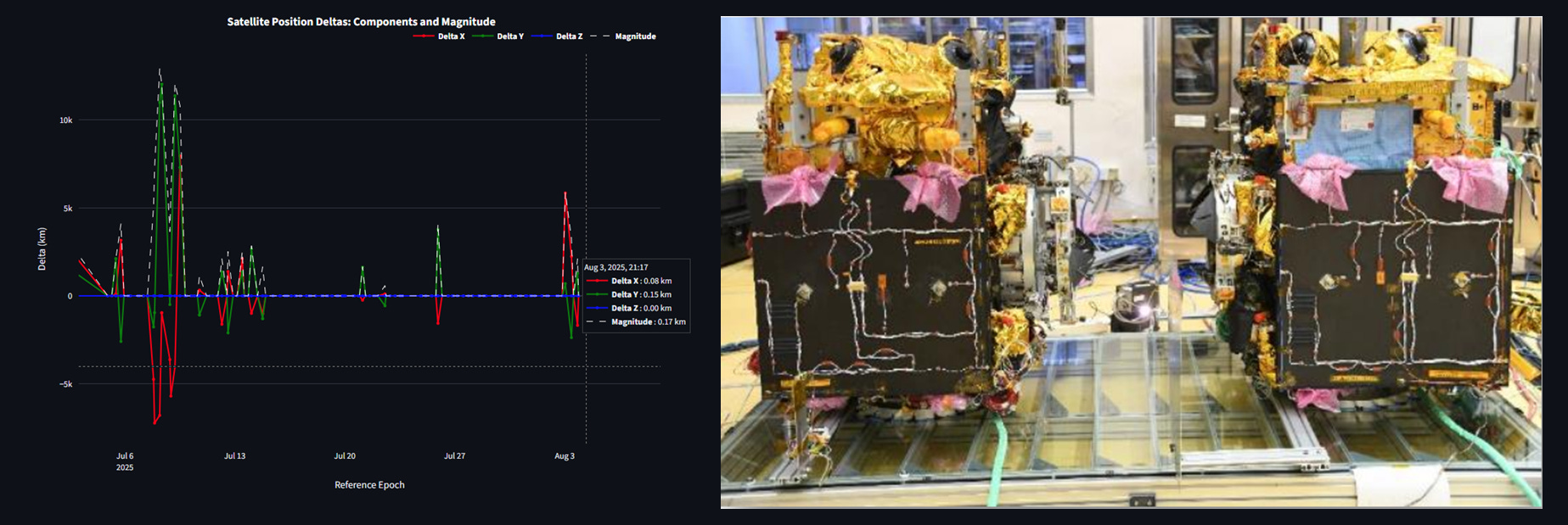
This commercial development complements ISRO's series of at least three SpaDeX missions (the first of which has already completed primary objectives with a budget of $16 million), demonstrating autonomous docking technologies with dual-use applications for future servicing missions.
Strategic Lessons by Orbital Regime
Indian planners must recognize that each orbital regime demands distinct servicing capabilities, each with unique opportunities and constraints - as evidenced by current global developments.
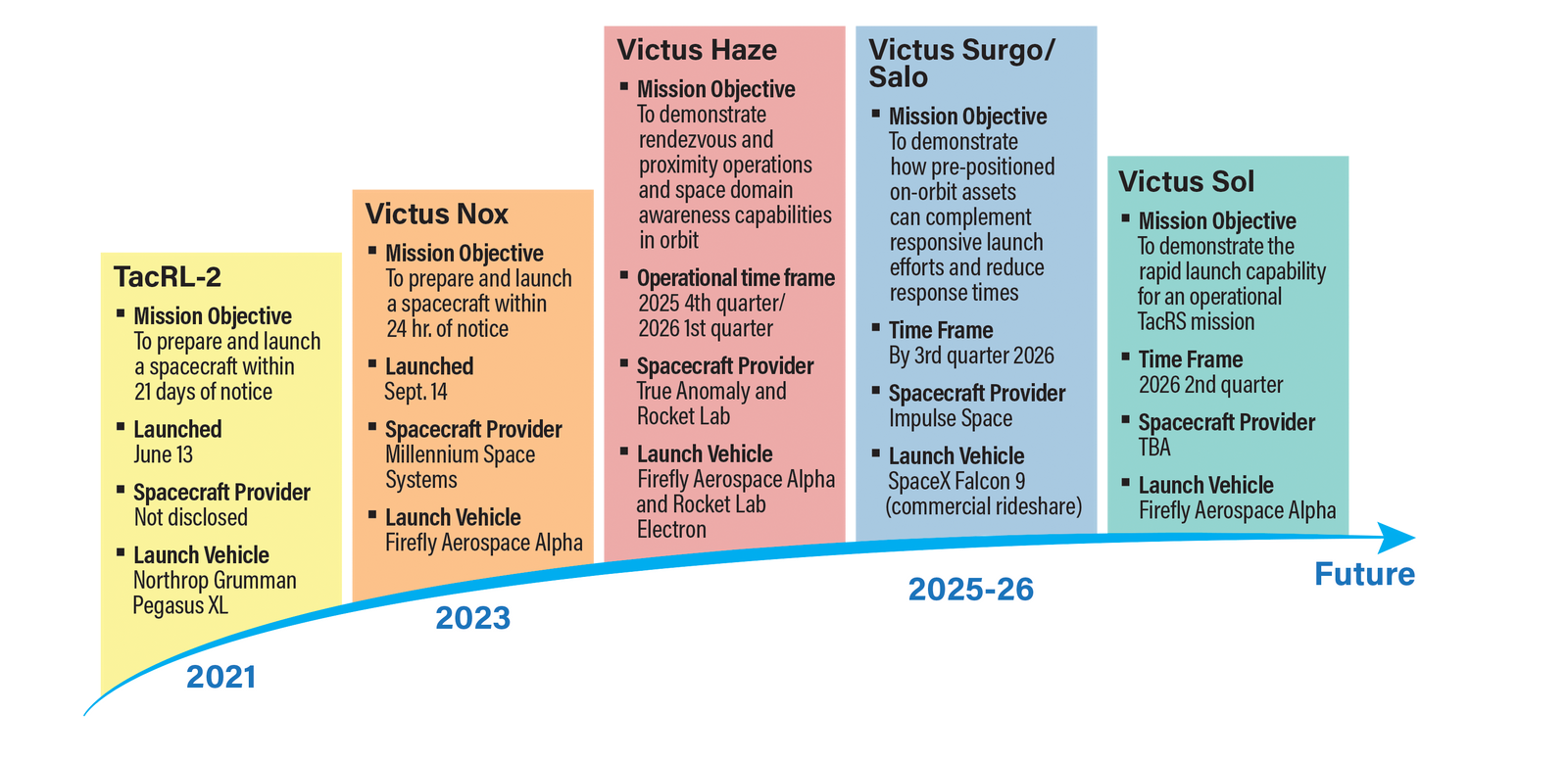
Low Earth Orbit: While proliferated LEO architectures are optimized for replacement, Strategic Layer capabilities create advantages during extended competition. The US Space Force's TacRS program demonstrates responsive inspection and intelligence gathering missions that can operate under cover of replenishment or disposal operations. Operational Layer debris removal platforms provide similar cover while enabling orbital repositioning and access control. Combined, these architectures enable rapid deployment of Strategic Layer assets, force multiplication through intelligence gathering, and plausible deniability where proximity operations appear as routine maintenance or cleanup missions. However, high cross-plane maneuvering energy requirements severely limit servicer reuse, often requiring dedicated platforms for multiple targets. India's emerging public-private partnership plans should consider incorporating similar dual-use capabilities that provide operational flexibility under contested conditions.
Medium Earth Orbit: Strategic Layer capabilities in MEO, as most MEO satellites are today used for critical sovereign positioning services that adversaries may target. MEO's isolation from other servicing platforms makes indigenous inspection capabilities essential for detecting constellation threats such as co-orbital weapons disguised as constellation spares. However, this represents the most challenging inspection environment as dedicated launches become immediately obvious, making MEO servicing missions signal clear strategic intent. This regime proves unsuitable for ambiguous operations but valuable for demonstrating resolve. While India's current NavIC operates in GEO and IGSO orbits for regional coverage, the proposed NavIC 2.0 system envisions MEO satellites to extend sovereign navigation services globally. Should India proceed with MEO deployment, developing indigenous inspection and threat detection capabilities becomes critical for protecting these assets from threats.
Geostationary Earth Orbit: Requires capabilities across all pyramid layers due to high-value, limited-number assets. Foundation Layer extends expensive satellite lives, Operational Layer enables orbital management and threat response, Strategic Layer provides domain awareness, while future Dominance Layer may enable space control. This regime provides optimal sustained servicing conditions through minimal propellant requirements and natural cover via planned relocations or unexplainable performance degradation. Russia's Luch/Olimp-K and US GSSAP missions demonstrate how strategic positioning enables sustained intelligence operations. India's GEO infrastructure through INSAT/GSAT platforms presents both opportunities for comprehensive OSAM capability development and requirements for protecting high-value assets.
Aligning ISRO & Industry for a Competitive and Interoperable OSAM Ecosystem
A coherent OSAM strategy calls for integrating ISRO’s technology development with commercial innovation and allied partnerships to build comprehensive capabilities across layers. ISRO's institutional role becomes critical for establishing sovereign and flexibly interoperable servicing standards and protocols to enable interoperability in the indigenous ecosystem.
ISRO should leverage SpaDeX lessons to mandate serviceability features for next-generation satellites, including standardized docking ports, power transfer interfaces, and propellant connection systems across future NVS navigation satellites and INSAT/GSAT platforms. With private companies like Ananth Technologies now building GEO satellites domestically, adopting ISRO's standards across both government and commercial sectors can create network effects that strengthen strategic autonomy.
The SpaDeX program provides foundational docking technologies while companies like InspeCity and OrbitAID can develop operational servicing capabilities. Where indigenous capabilities prove economically challenging, India can pursue partnerships leveraging soft-power advantages and growing space technology reputation, demonstrated through commercial partnerships with firms like Dawn Aerospace.
This approach builds strategic autonomy in Foundation and Operational Layer capabilities where domestic industry can compete, while maintaining resilience through international partnerships in resource-intensive upper layers. The result positions India as a regional space power through smart resource allocation and standards leadership rather than attempting to match larger powers across all domains.
G. Closing Thoughts
Governments must prioritize crisis resilience over peacetime optimization. Commercially optimized solutions create dependencies that adversaries exploit through targeted disruption, making architectures with gradual degradation under stress more valuable than those offering peak performance but cliff-edge failures.
Democratic space powers must distinguish between two types of commercial solutions: those optimized specifically for peacetime military procurement (which create dependencies) and those developed for independent commercial markets. The latter approach allows market mechanisms to serendipitously generate strategic solutions that formal military planning often struggles to articulate, as demonstrated by companies like HEO Robotics and Northrop Grumman.
Nations developing resilient OSAM architectures will secure decisive advantages in extended competition where conventional replacement mechanisms fail. Like reusable launch revolutionizing space access economics, space servicing represents a paradigm shift that fundamentally alters strategic balance by transforming inherently vulnerable space architectures into asymmetric advantages through sustained operational capability rather than replacement-dependent resilience.
Part III will examine how commercial space servicing markets are evolving in response to these strategic requirements, what opportunities exist for dual-use development serving both commercial and military needs, and how nations can structure policies to bridge the gap between commercial innovation and strategic necessity. The stakes could not be higher: the strategic frameworks chosen today will determine which nations can sustain space operations in the contested orbital environment of tomorrow.
I hope you found this article useful. Please feel free to share this and others with your friends and colleagues. Connect with me on LinkedIn or email if you are looking for more detailed information on the topic or to collaborate.